
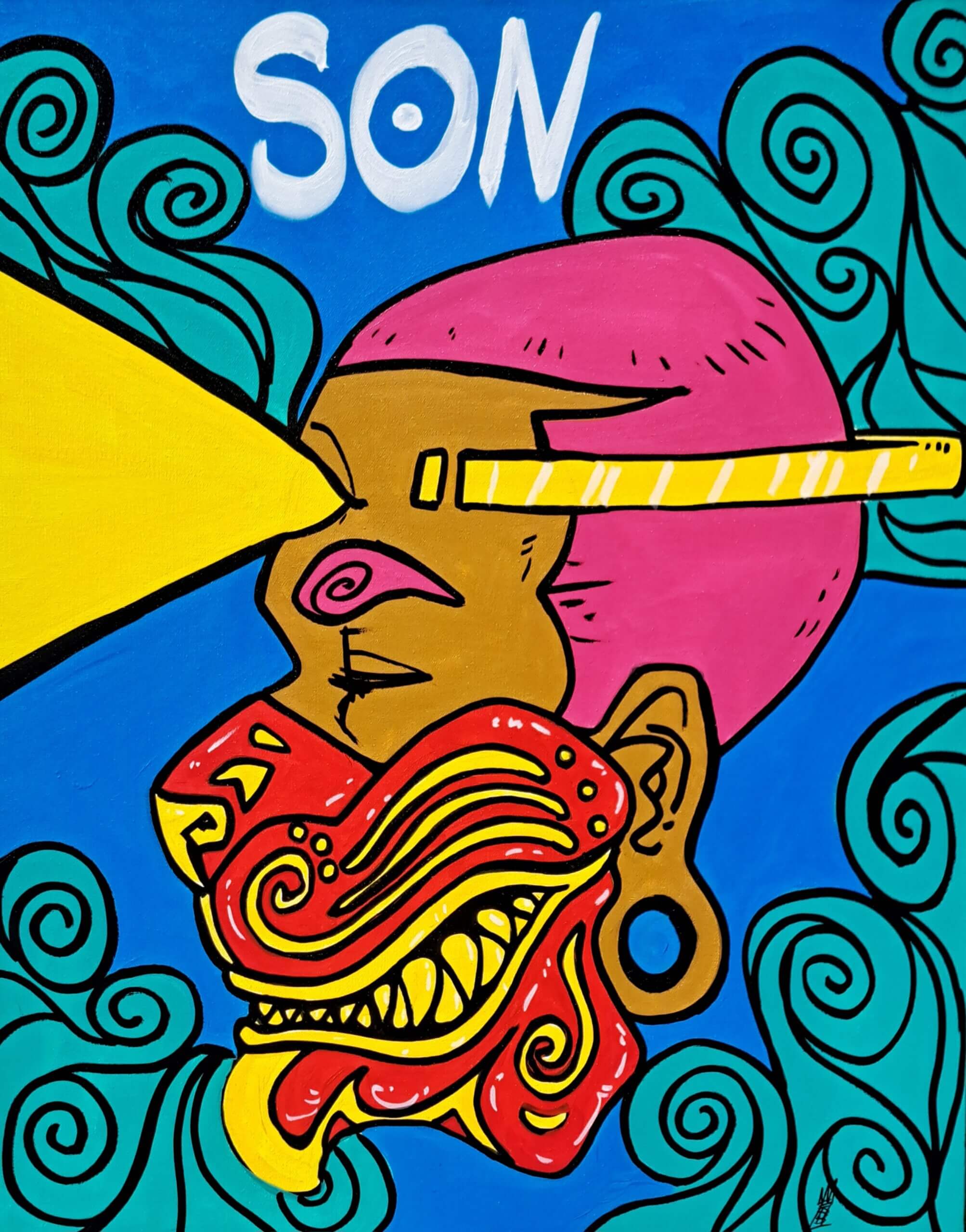
Stand in front of one of Dominique Hodge’s paintings long enough and something unexpected happens.
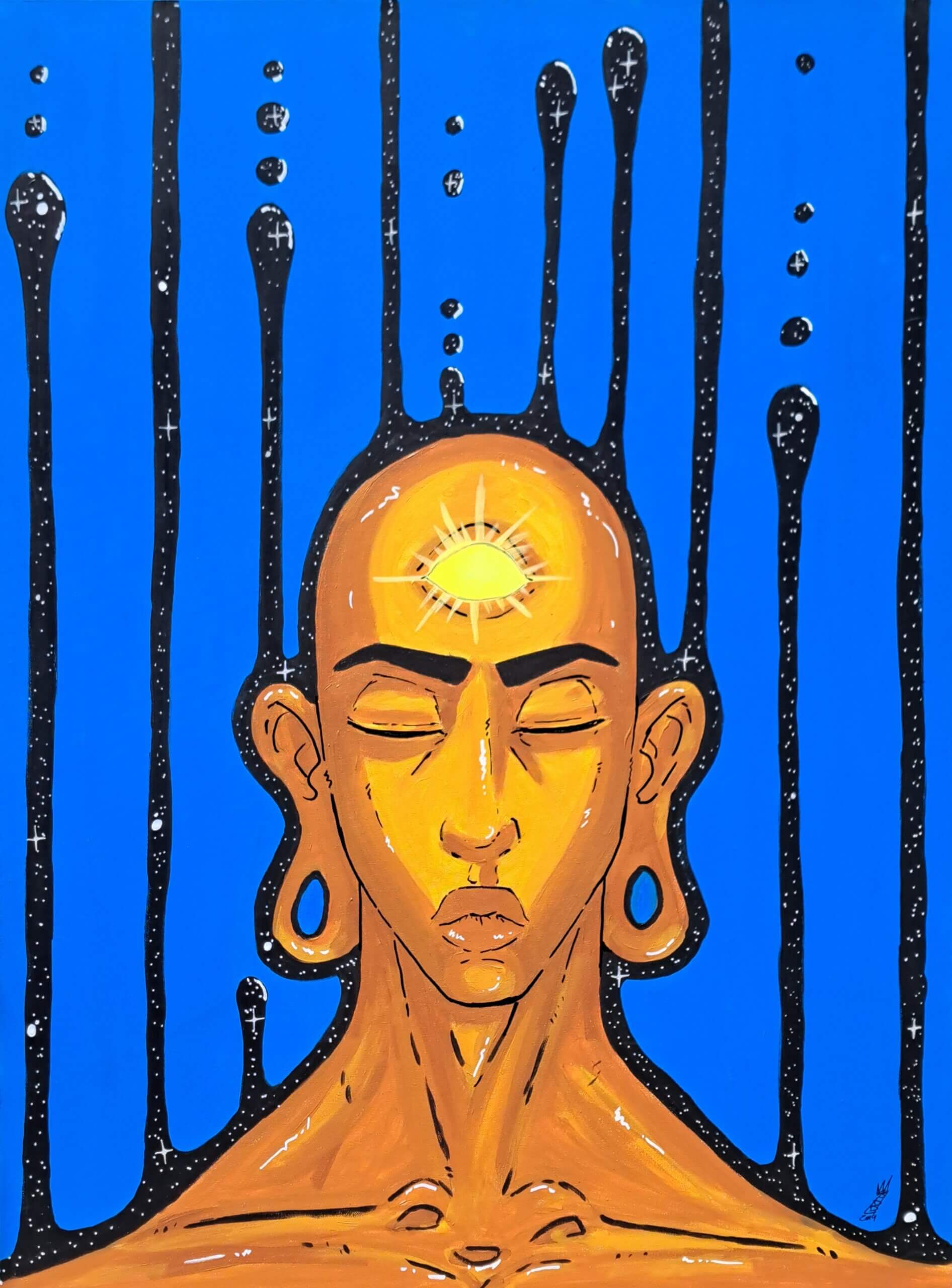
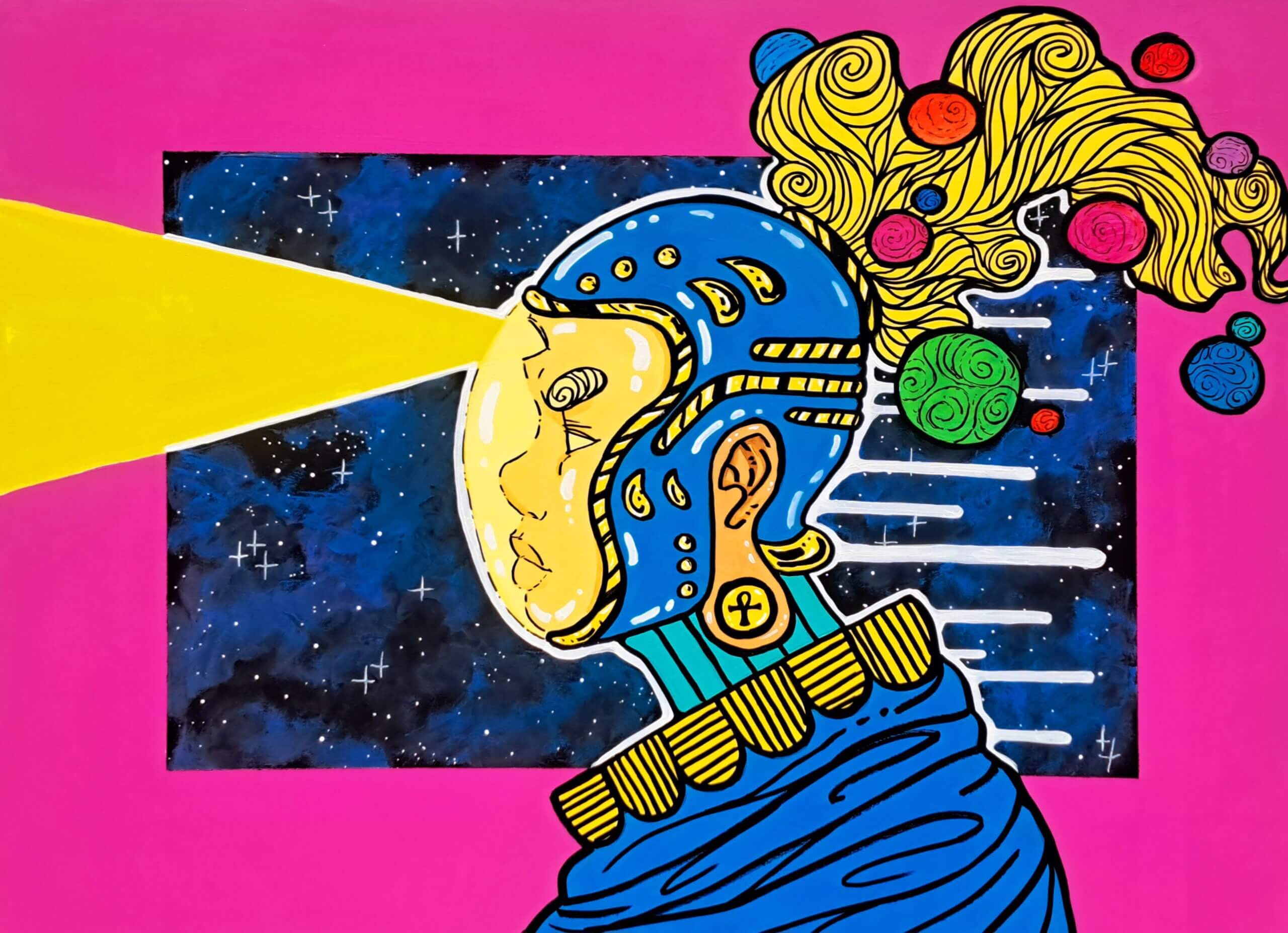
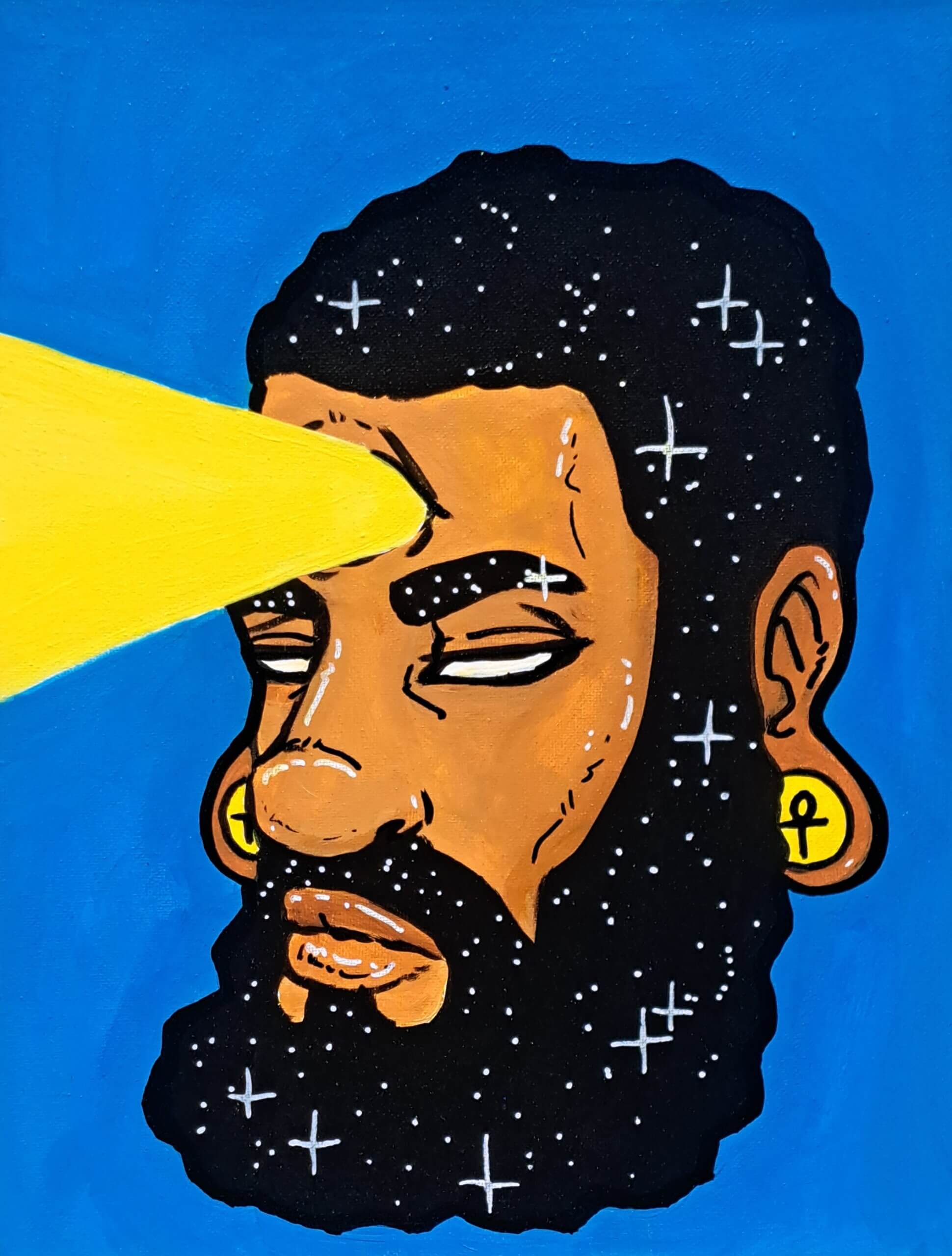
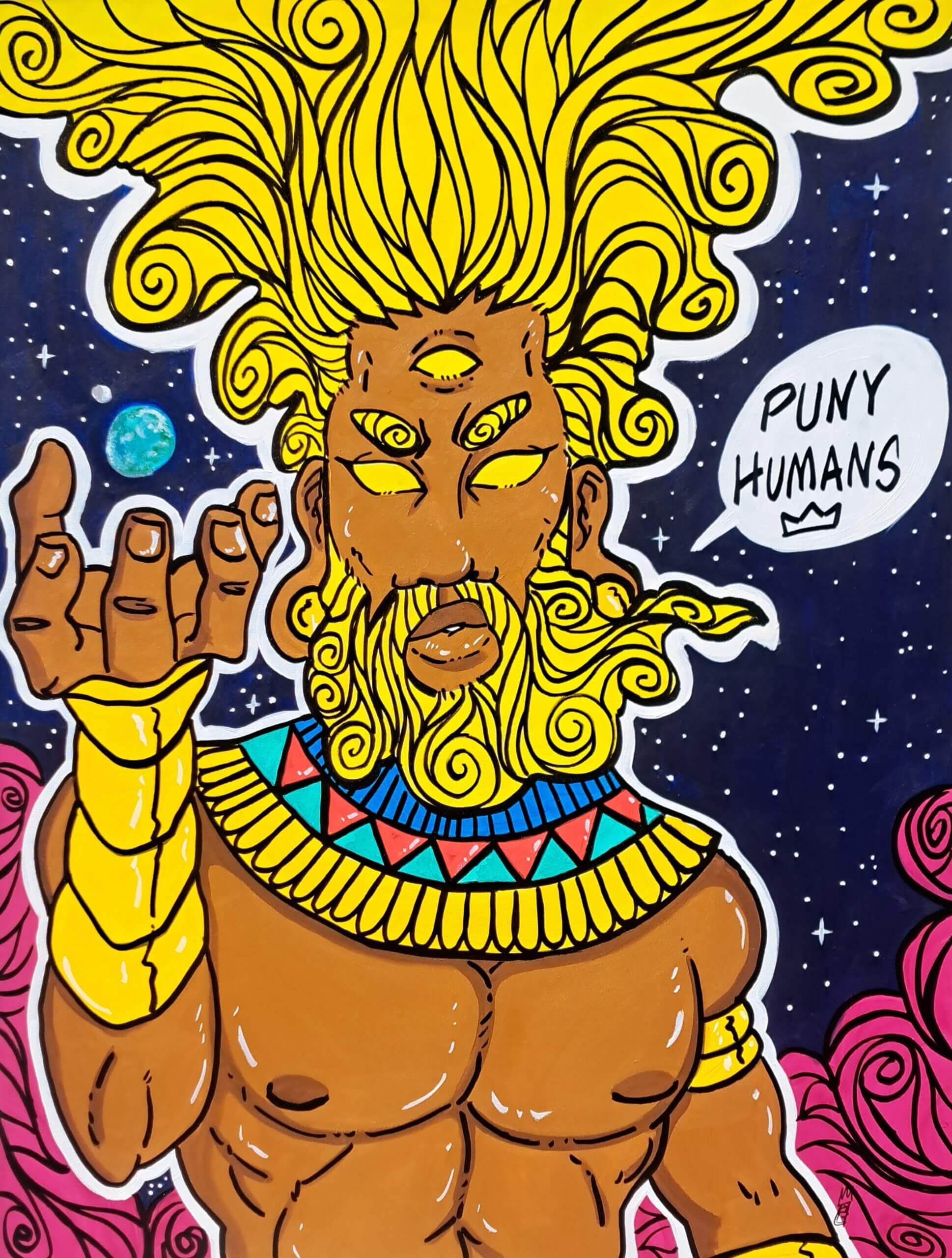
A dark-hued figure commands the canvas, cosmic in setting, luminous in presence with light radiating from the third eye. The colors are vivid, the symbolism layered. You start to notice what you’re actually looking at. And then, if you’re paying attention, Hodge will tell you what he sees from across the room: the moment your mind turns on.
“You see a light come on,” he says. “A lot of times we’re existing in a haze. This work wakes you up.”
That light is not decorative. It appears in every piece Dominique Hodge creates, both his signature and his mission encoded into paint. And it started with a kid in Sumter, South Carolina, who couldn’t find himself anywhere in art.
Notebooks and a Name He Gave Himself
Hodge grew up in Sumter, filling notebooks with characters from Pokémon, Dragon Ball Z and Naruto. By sixth grade he knew he wanted to be an animator. The drive was real but the reflection wasn’t there.
It wasn’t until he enrolled at The Art Institute of Charleston that he found what was missing. In college he encountered Black representation in fine art for the first time — Black artists, Black subjects and Black identity rendered as power rather than problem. The revelation was immediate and transformative.
“I could create artwork that reflected myself and those who looked like me,” Hodge said. That realization became a life’s mission.
Known artistically as Jakeem Da Dream, the name carries that philosophy forward. It’s not a stage name. It is an affirmation he authored for himself. Jakeem stands for “just a king enjoying everyday moments.”
He explains it plainly: “No one else can give you that name. You have to name yourself.” Every stroke of the brush, every line drawn, every mistake made, all of it is part of the process of becoming. That is what the name reminds him to honor.
Afro-Alchemy: Art as Energy Transfer
Hodge’s recent exhibition “The Art of Afro-Alchemy” at Sumter County Gallery of Art is not easily categorized.
His work draws from mythology, religion, history, astrology, astronomy and Hermetic philosophy. Vibrant color does emotional work. Symbolism layers beneath symbolism. He describes himself as an alchemist in the most literal sense.
“Being capable of converting pain, suffering and joy into a physical manifestation is pure magic,” Hodge says. Every piece costs him something — hours without food, water, or rest while he’s locked in a creative state. “You feel the energy leave you when you’re creating. My soul is put into each piece.”
“I’m taking something ethereal and solidifying it, presenting it to the world. That, I think, is the ultimate sacrifice.”
The third eye motif that appears across his work is not decoration; it is instruction. Hermetic philosophy centers on enlightenment and Hodge designs his work to trigger it. “My work is light,” he says. “It’s designed to enlighten those who are ready for it.”
He does not explain his pieces to viewers. He asks them what they see because the art is alive, he believes — alive and growing with every new interpretation.
The imagery also carries a deliberate social argument. Hodge believes what we see shapes how we perceive ourselves and others. The negative imagery that has historically been applied to Black people from Jim Crow caricature to contemporary media stereotypes is absorbed and internalized.
Hodge intentionally creates the counter-image of positive, purposeful and powerful Black figures in cosmic settings. “I want my work to awaken the god within every melanated person that beholds it,” he says, “and instill a state of reverence in the non-melanated viewer.”
The Prophet Who Stayed
Hodge has traveled and worked throughout eastern South Carolina from Spartanburg to Greenville to Lake City to Charleston and beyond to North Carolina, Georgia and Florida. He is connected to Roc Bottom Studios and Gemini Arts in Columbia and has built lasting relationships across the ArtFields scene in Lake City.
He could live and work anywhere. He chooses Sumter. Deliberately.
His reasoning is pointed. South Carolina has produced extraordinary creative talent, such as Eartha Kitt, James Brown and Chadwick Boseman, he said, artists who left because they weren’t seen here. “Most people don’t know that,” Hodge says, “because they weren’t appreciated here, so they took their talents elsewhere.”
He chose a different path. Staying is an act of loyalty and a form of advocacy for Hodge.
“You do a disservice by not honoring your homeland. There are amazing creatives here. There are extremely intelligent people here. I want to draw the attention that helps build and grow the arts in Sumter.”
He sits on the board of Sumter County Gallery of Art and has taught youth art classes and led sip-and-paint events. For eight years he has worked with the Auntie Karen Foundation’s Artpreneur Program, placing working artists in rural South Carolina schools to provide genuine arts education to children who might otherwise have none.
The Alchemy Goes Both Ways
Teaching children, Hodge says, is where his own creative deconstruction happens. Kids turn in projects done in ways he never imagined. They smash assumptions he didn’t know he had.
“The alchemy works both ways,” he says. “I have to deconstruct some of my old ways of thinking and reconstruct them into something new. And the catalyst for that is these kids.”
What he wants them to take away is simple and radical at once. He wants a Black child in Sumter to walk through his exhibition and feel seen. To feel that can’t is a word that doesn’t apply to them. To look at a figure radiating light and think: If they can do this, why can’t I?
Oven-Baked, Not Microwave-Ready
Hodge has been building his foundation for over a decade. The past three or four years are where he’s begun to see the return on that investment. He pauses before he says this, aware of what it took to arrive here.
“I want my success to be oven-baked, not microwave-ready,” he says. “The microwave is quick, but it’s not going to satisfy. It has cold spots in the middle. The home-cooked meal lasts.” He is patient in the way that people are patient when they have both vision and self-belief, when quitting was never actually an option.
He has a question he asks himself every day. He asks it of the kids he teaches, too.
“Would the child in you be proud of you? If you can say yes to that every day, you are winning.”
“This is my favorite time of my life. And I know it’s going to get better.”
He is looking outward now to national exhibitions, international reach and collaborations not yet imagined. But his roots are in Sumter, the city that shaped the kid who didn’t see himself in art. Now the artist Jakeem Da Dream is creating the light he needed, for every generation that comes looking for it after him.
Dominique Hodge’s work can be found on Instagram at @dadreamdesigns. Follow his journey and the stories Millican Arts is telling by subscribing to The Story Circle newsletter and on the Millican Arts Facebook page. Because every story matters.